
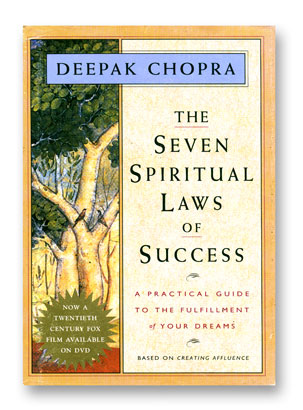
I’m sure that most of us have heard of Deepak Chopra, as a renowned spiritual figure; his book: The Seven Spiritual Laws of Success, is equally as famous as he is.
When I first picked up this book, it was to understand the deeper nuances of what it means to be a successful person. Now, reading it for the second time, there are many other things that I have gleaned from this text.
Chopra is truly writing about the ability for each one of us to discover our life purpose and passion. He asserts that in order to achieve our purpose, we must be in tune with the flow of life, and not resist nor condemn any situation that befalls us. Everything we do must be done from a place of passion and love, and that will result in success.
This is easier said than done.
One of the most interesting points that he makes is that we all have karma, or baggage that we accumulate throughout this lifetime. He states that we can either allow bad karma to negatively affect us, or use it to guide us towards our dharma—our purpose.
Ultimately, we have the choice.
I’ll provide an example: perhaps someone is laid off from a job that they thought was extremely important to them (this could be a result of some karma or a lesson that they need to learn). Instead of reacting negatively to the situation, they have the choice to look at it as an opportunity to follow a different path or passion that may align with their soul more.
Chopra’s book implies that success is never a destination, but a path that we select: a lifetime of decisions built on top of each other.
And the first step starts with changing ourselves.
The laws outlined in this book show how mindset plays a crucial role in our ability to achieve success. If you are constantly operating from a mindset of lack, versus a mindset of abundance, nothing will ever work out for you.
Likewise, if something isn’t going your way, and you deplore: nothing will ever work out for you, nothing ever will.
It becomes a self-fulfilling prophecy of sorts.
The book begins with the Law of Pure Potentiality —the idea that we can manifest everything we dream into existence.
This chapter commences with a quote from the Rig Veda:
“In the beginning there was neither existence nor nonexistence,
All this world was unmanifest energy….
Nothing else was there.”
Many times we are blinded by our belief that something is impossible when we need to realize: the very probability of our universe existing is a miracle.
If our existence is a miracle, then who’s to say that we do not have the power to create our own miracles???
We will only have the power if we learn to believe in ourselves, and the mysterious universe in which we live in.
Trees do not wish to grow, they simply do.
Tides do not wish to change, they simply do.
The same can be said of us: we need not wish for success because it is our birthright.
If you are interested in reading this book, I highly encourage you to do so, I’ve outlined Chopra’s 7 laws of success, below as a reference:
- The Law of Pure Potentiality
- The Law of Giving
- The Law of “Karma”
- The Law of Least Effort
- The Law of Intention/Desire
- The Law of Detachment
- The Law of Dharma
 Mind, Body, Soul
Leave a comment